Physical Address
304 North Cardinal St.
Dorchester Center, MA 02124
Physical Address
304 North Cardinal St.
Dorchester Center, MA 02124
Roblox is not only a game but it is a platform, a marketplace and a virtual economy powered by millions of users.
Well most of games earn money by direct selling games or through in-app purchases but Roblox have tried completely different more scalable a user-generated content ecosystem in which players can create content and other players can play it.
Now let’s take a look how exactly how Roblox is making money.
Like all other traditional games like Minecraft, Fortnite or GTA, Roblox have not focused on a single gameplay loop.
But instead of it have:
Players not only “play” Roblox but they also create, monetize, trade, and socialize inside it.
This is major key difference between other games and Roblox because it more like a play store of games or can be as gaming hub instead of a game.
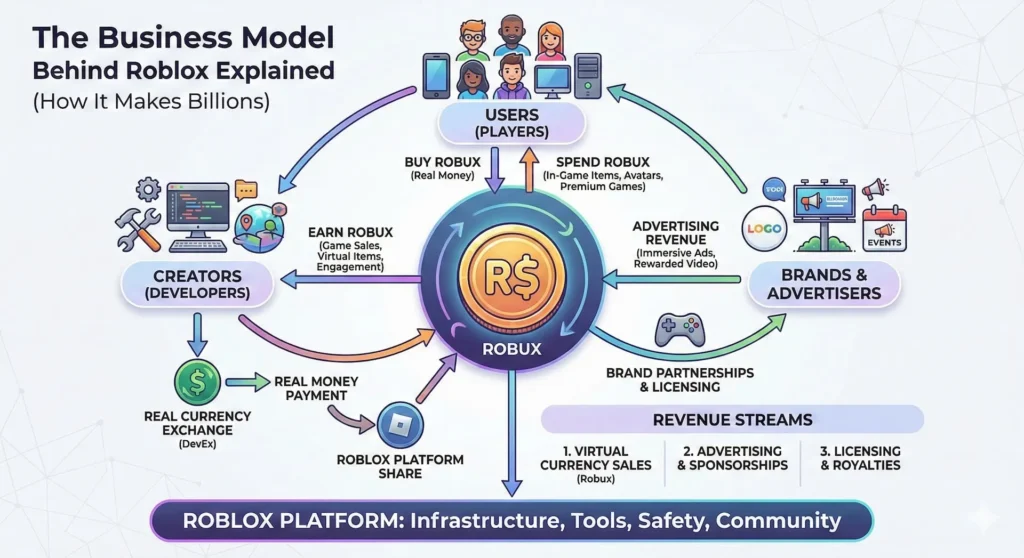
Robux is the backbone of Roblox economic because player buy Robux with money.
Then they use Robux for:
Roblox earns take a percentage cut whenever someone spend Robux inside its ecosystem.
This creates a closed economic loop where player spend in experience or anything then developer and Roblox with share it.
Roblox have allows independent developers for:
When any users spend Robux then Roblox keeps a platform fee and rest goes to developer.
It is quit similar to:
But here is a key difference:
Roblox developers don’t need any marketing budget because platform itself drives discovery so don’t have to advertise or anything they just have to create a outstanding game and Roblox did everything for it.
Roblox offers a Premium Membership which provides:
Recurring subscriptions create a predictable revenue streams which something investors value heavily.
Major brands also run virtual events and ads in Roblox.
Examples like:
And this turns Roblox in a digital social metaverse platform so it is not just a gaming app but a gaming hub and metaverse platform
Roblox is one of the largest interactive platforms in the world with.
High engagement is always foundation of any game and its monetization model success.
Roblox mainly generates revenue by sale of its virtual currency Robux which is :
Unlike all traditional AAA titles like Grand Theft Auto V which rely on upfront purchases but Roblox is continuously earning by micro transactions.
This constant content refresh gives Roblox a structural advantage over all other fixed title games like Minecraft or Fortnite.
Roblox succeeds because it combines:
Players not only consuming content but they are also aspiring to become creators.
Which creates:
Roblox grows have not declined after launch like all other traditional games because its users continuously build new experiences which keeps it refreshed and new.
Here is real growth loop:
This loop have created a self sustaining ecosystem only few gaming platforms have achieved this large scale.
Well like everything no system is perfect so how Roblox can be.
So Roblox faces:
But platform model gives it resilience.
Roblox is making money through:
The key insight?
Roblox is not selling games but It is selling a digital economy.
And that’s why it became one of the most powerful gaming platforms in the world.