Physical Address
304 North Cardinal St.
Dorchester Center, MA 02124
Physical Address
304 North Cardinal St.
Dorchester Center, MA 02124
Let Be Honest how many times you’ve said before that.
“Okay, just only one more match.”
and 30 minutes later you’re still playing.
You don’t have won most of matches and in most of sessions you must have eliminated early and maybe sometimes someone killed you in few seconds.
But still you are still pressing Ready again button again and again and This is not happening by accident but game is well designed to do so.
Fortnite did not become so popular just because it is free and colourful but because it understands player psychology to retain them for a much longer time.
That is Human behavior.
Now let us break down everything to know why this game have hooked millions of users to play and why even when players “quit” somehow come back again to play.
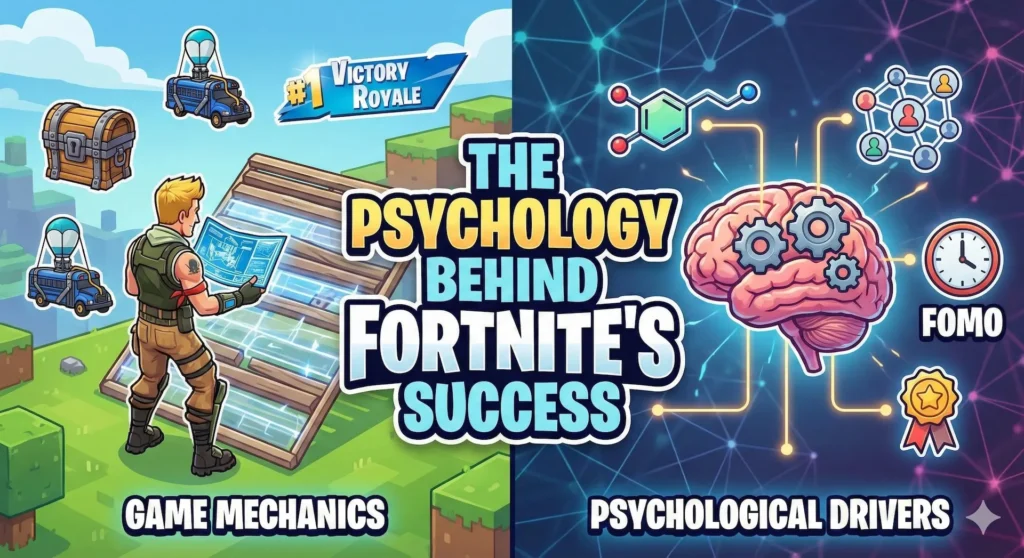
There are 100 players who enter in a Fortnite match and out of it only one wins.
Statistically your chances of winning are very small.
But you rarely loose in such a way that you feels like hopeless or like you are wasting time without any progress.
Instead of it you will:
So each match feels like progress for you.
Psychologically this creates a variable reward loop. This reward (Victory Royale) is unpredictable and this unpredictability increases release of dopamine.
When you are almost about to win then your brain told us:
“You were close. Try again just once more.”
This “almost win” is a way more addictive than guaranteed win.
If winning were easy in match then it begin to feel meaningless for us.
Fortnite have made victory a lot rare just 1 in 100 and this rarity increases value. Because whenever we got anything easily then we don’t value it like it.
Most battle royale games focus on aims but Fortnite have added building and this has changed everything.
Now success isn’t just only about shooting with accuracy but It’s also about:
Two players can have identical weapons and can have completely different outcomes depending on building skill.
Which create a high skill ceiling in players.
and high skill ceilings are dangerous in a good way because when you lose that loose doesn’t feel random. Instead It feels personal.
You think:
“He was faster than me.”
“I need to practice more.”
“I messed up that wall placement.”
This sense of control keeps you invested and keep replaying.
Humans are wired for pursuing mastery and when improvement feels possible for us then quitting feels premature.
Now let’s talk about skins. Logically they don’t improve gameplay but emotionally they matter. Because in real world book is judged by its cover.
A rare skin silently communicates:
It’s a social signaling.
Humans always want to displayed status by clothes, cars, watches and Fortnite digitized that instinct.
And here’s what’s powerful:
Skins connect us to memories.
When you see a specific skin then you might remember:
Now it’s not just like an item but It is now a emotional attachment.
That’s why people spend money on cosmetics in a free game.
They’re not buying pixels. They’re buying identity.
Fortnite mastered one psychological trigger better than almost any other game:
FOMO.
Live concerts.
Limited-time modes.
Map-changing events.
Exclusive battle pass skins.
If you miss it then it’s gone completely and forever.
And humans hate missing unique experiences.
Even players who say, “I’m done with Fortnite” often log in back when a new season drops.
Why?
Curiosity + urgency.
“What changed?”
“What if this season is amazing?”
“What if I miss a rare skin?”
Scarcity increases perceived value. If something is less available then more important it feels.
Fortnite isn’t only engaging because of gameplay. but It is engaging because of shared emotion of friends and players.
A solo win feels good but a squad win feels unforgettable.
Because:
Emotions are stronger in groups and those emotional memories become tied to game itself.
Sometimes players don’t return because of Fortnite but they return because their friends are online.
Fortnite becomes social space not just a game and that shift from “product” to “social environment” is very powerful.
Imagine if Fortnite launched at $60 then many players would have never tried it.
By being free it removed:
You could download it “just to try.” and once inside game then experience does rest.
After 20–30 hours of fun on a game buying a skin doesn’t feel like spending. It feels like appreciation and this psychological shift is subtle but effective.
The player feels in control and control reduces resistance.
One of the biggest reasons games die? Stagnation.
But Fortnite rarely feels static because:
Maps evolve.
Weapons rotate.
Mechanics adjust.
Collaborations appear.
Every new season feels like a refresh and your brain loves novelty.
When something feels new, attention increases and if something feels predictable, attention drops.
Fortnite continuously feeds novelty without breaking familiarity which create a delicate balance.
At some point Fortnite stopped being just as a battle royale.
It became:
This expansion increased relevance even for people who don’t play regularly still care about major updates.
It lives in online conversation and cultural presence strengthens psychological presence.
If everyone talks about something then it start feels important.
Let’s be honest winning feels good for one deeper reason:
Validation.
When you win:
This triggers ego reinforcement.
Fortnite makes victory visible.
It publicly acknowledges your success so recognition strengthens behavior.
If nobody saw your win then it would feel weaker so Fortnite makes sure it feels big for you.
Many players say they’re tired of Fortnite but months later they return again.
Why?
Because game evolves and curiosity is so powerful.
Humans are very uncomfortable with uncertainty.
So when a new season launches then brain wants answers:
That unresolved curiosity pulls players back and Fortnite never allows closure.
And psychologically unfinished experiences are too harder to forget.
When we talk about why Fortnite is so addictive psychology explains behavior but numbers actually prove that massive scale.
Let’s look at real data behind its dominance.
That scale creates something powerful: constant competition and fresh opponents. You’re never playing against bots forever. You’re mostly playing against real unpredictable humans.
And that unpredictability keeps your brain engaged.
What makes this impressive?
Fortnite doesn’t sell power. It sells identity.
Players willingly to spend money on skins which don’t affect gameplay. Which only shows how strong emotional connection really is.
Fortnite succeeded because it aligns with core human drives:
They didn’t just create a good game but they engineered engagement.
And that’s why, years after release it’s still part of gaming culture.
Not because it was first. Not because it was lucky. But because it understands players better than most games do.
Here’s a simplified breakdown before we go deeper:
| Psychological Trigger | How Fortnite Uses It | Why It Works |
|---|---|---|
| Variable Rewards | Unpredictable wins & loot | Dopamine spike keeps players retrying |
| Skill Mastery | Advanced building mechanics | Players feel control & improvement |
| Social Identity | Rare skins & cosmetics | Players express status & identity |
| FOMO | Limited-time events & battle passes | Urgency increases engagement |
| Social Bonding | Squad gameplay | Emotional memories increase loyalty |
| Novelty | Seasonal updates | Prevents boredom |