Physical Address
304 North Cardinal St.
Dorchester Center, MA 02124
Physical Address
304 North Cardinal St.
Dorchester Center, MA 02124
In 2017 multiplayer gaming was changed permanently.
Before that shooting games were mostly about respawns, team deathmatches and are short rounds. Then a game was released and then millions of players were jumping out from a plane to a massive open island, scrambling for weapons and fighting for being the last one alive.
That game was PUBG: Battlegrounds.
It didn’t invent battle royale concept but it was first game that made battle Royale global. Today almost every major multiplayer game franchise have a battle royale mode in it but this explosion was first started with PUBG.
Let us break down everything exactly how it was happened.
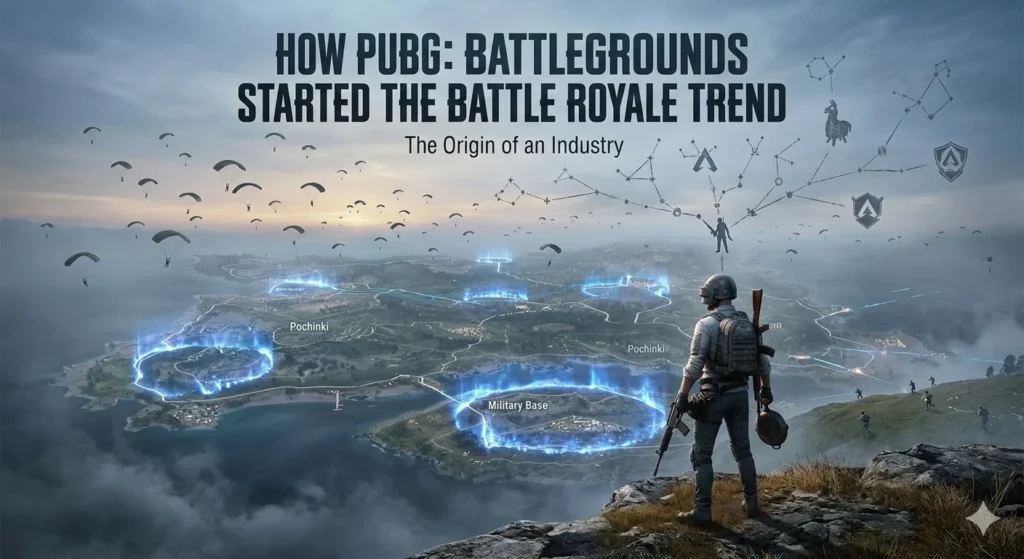
Battle royale formula is very simple at its core :
This tension of knowing that one mistake will ends your entire match. This is what made PUBG feel different.
Battle Royale concept was actually first evolved from mods created for ARMA 2 where developer Brendan Greene experimented with survival-based multiplayer but PUBG was the first time where idea was packaged into a polished standalone experience.
Many games launch every year and only very few reshape gaming industry. PUBG did this in three major reasons.
Unlike later competitors PUBG focused on realism:
Original Erangel map felt grounded and dangerous. Every open field was risky and every gunshot meant like someone might be hunting you.
This grounded tone have attracted serious competitive players.
PUBG was built for content so every match have created unpredictable moments:
Platforms like Twitch and YouTube amplified these type of moments so watching someone survive with chaotic last circle is almost feel as exciting as playing by your own.
And this organic exposure pushed PUBG to a record breaking numbers.
At one point PUBG was reached at over 3 million concurrent players on Steam setting a platform record at that time.
Most shooters allow respawns but PUBG didn’t.
If you died early then that was it.
This created:
Winning a PUBG match felt rare and because it was rare so it felt valuable.
This design decision have changed multiplayer psychology.
Once PUBG proved battle royale can attract millions of player then whole gaming industry reacted to it immediately.
Major studios started to adapt this formula. Some of them are
Originally planned as a co-op survival game but Fortnite pivoted to battle royale mode after PUBG’s massive success. It added:
Fortnite made it’s battle royale more accessible.
Respawn Entertainment introduced:
Apex refined that formula for competitive depth.
Warzone integrated battle royale into an already established franchise by adding:
Within 3 years battle royale became a permanent pillar of multiplayer gaming.
And that wave started because PUBG proved this model will work.
In 2018 PUBG Mobile was launched and it was the real turning point for it.
Because smartphones made battle royale accessible to millions who didn’t own gaming PCs or consoles.
In India especially:
PUBG Mobile became more than a game and became a cultural phenomenon.
Local tournaments exploded. Streamers gained massive followings. Gaming cafés were replaced by mobile squads which were playing together at home.
For many Indian players PUBG Mobile was their introduction to serious multiplayer gaming.
PUBG wasn’t just popular because of mechanics but because It tapped into deep psychological triggers.
Out of 100 players only 1 will wins.
This 1% success rate makes victory a lot more meaningful are rare.
And when something is rare then brain values it more then easily available.
Every match is different.
Uncertainty increases engagement and you will never know how a match will unfold.
Blue zone eliminates passive play. Even defensive players are eventually forced into conflict.
So This guarantees dramatic endings of almost every match.
Squad mode strengthened friendships:
This cooperative survival loop increased retention dramatically because anything playing together have an emotion.
Very few games in history have influenced industry trends so quickly.
Technically, no.
This idea was inspired by earlier survival mods and even older concepts from survival fiction. However PUBG:
That’s what matters.
It didn’t invent spark but it built the fire.
Now competition is much more stronger.
Graphics have improved. Mechanics have evolved. New battle royale games offer faster pacing and flashier features.
However:
For players who prefer realism over arcade style PUBG still delivers a unique experience for them.
Today battle royale is no longer a trend. It’s now a permanent genre.
Without PUBG:
PUBG reshaped:
That’s not just success that’s industry transformation.
| Game | Core Identity | What It’s Known For |
|---|---|---|
| PUBG: Battlegrounds | Tactical Survival | Realism, tension, military gameplay |
| Fortnite | Creative Combat | Building mechanics, fast edits |
| Apex Legends | Hero-Based Squad Play | Unique character abilities |
| Call of Duty: Warzone | Franchise Integration | Loadouts + Gulag respawn |
| Factor | PUBG | Fortnite | Apex Legends | Warzone |
|---|---|---|---|---|
| Realistic Gunplay | ⭐⭐⭐⭐⭐ | ⭐⭐ | ⭐⭐⭐ | ⭐⭐⭐⭐ |
| Fast Movement | ⭐⭐ | ⭐⭐⭐⭐ | ⭐⭐⭐⭐⭐ | ⭐⭐⭐ |
| Strategic Positioning | ⭐⭐⭐⭐⭐ | ⭐⭐⭐ | ⭐⭐⭐ | ⭐⭐⭐⭐ |
| Learning Curve | High | Medium | Medium-High | Medium |
| Solo Play Experience | Strong | Strong | Squad-focused | Mixed |
| Category | PUBG | Fortnite | Apex | Warzone |
|---|---|---|---|---|
| Mobile Popularity | Massive (especially India) | Moderate | Limited | Limited |
| Esports Growth | Strong in Asia | Global | Competitive scene | Competitive |
| Cultural Influence | High | Extremely High | Growing | High |
PUBG didn’t just launch in 2017 but It also have redefined multiplayer gaming.
It showed that:
Even if newer games dominate headlines today but every modern battle royale owes something to PUBG.
And that’s why its impact on gaming history can never be ignored.