Physical Address
304 North Cardinal St.
Dorchester Center, MA 02124
Physical Address
304 North Cardinal St.
Dorchester Center, MA 02124
For years battle royale in India means only one game : PUBG.
But then suddenly everywhere like in local trains, college canteens, coaching hostels people were playing Free Fire instead PUBG.
Most articles said same thing: “PUBG got banned” or “Free Fire worked on low-end phones.”
But it is only half story.
Real reason Free Fire overtook PUBG Mobile in India is far more strategic and almost no one talks about it properly. So lets talk about it in a more detailed way.
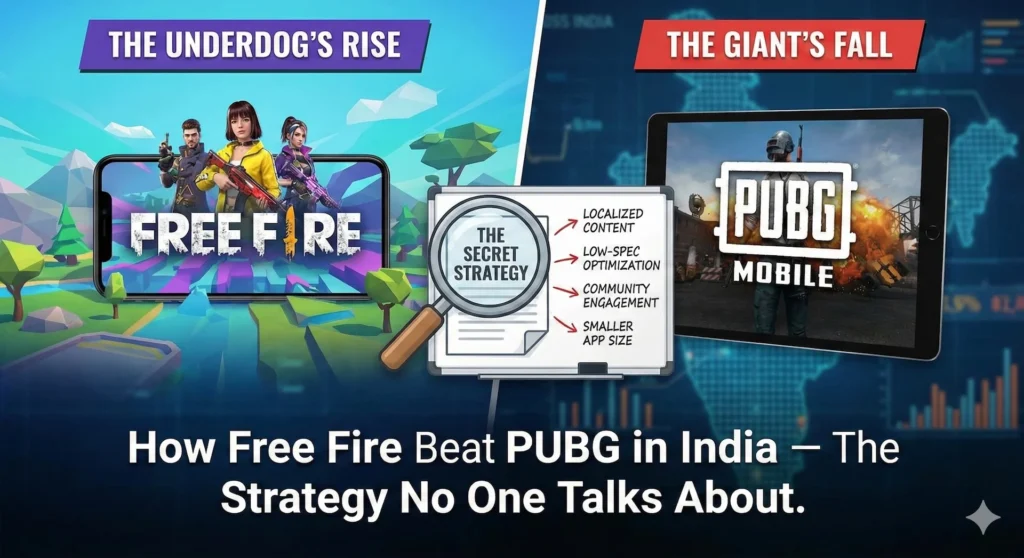
PUBG targeted competitive core gamers but Free Fire targeted India.
This difference have changed everything for its success in India.
Instead of building its game for high-end flagship devices Free Fire optimized aggressively:
At that time when most Indian users had:
So Free Fire can ran smoothly on any type of device.
PUBG looked premium and Free Fire looked playable.
In mass markets like India playable beats premium because everyone can’t afford a high end device.
PUBG matches: 25–35 minutes
Free Fire matches: ~10 minutes
This matters more than people realize.
Indian students and young players often:
Free Fire’s quick matches fit perfectly in this pattern.
It wasn’t just a game it fit perfectly in daily life. Session time matter more then you think you mostly have seen most high user base games like candy crush, subway surfer and a lot have short session time.
Free Fire mastered dopamine loops.
Compared to PUBG:
Even if you lost you still got:
Players felt rewarded after every session.
PUBG rewarded skill while Free Fire rewarded participation.
In a price-sensitive young audience market this is a massive difference.
Before big esports leagues became mainstream Free Fire aggressively supported regional creators.
Creators like:
They built massive rural and Tier-2 audiences.
PUBG initially focused more on competitive esports and metro audiences.
Free Fire focused on:
That built emotional loyalty.
Here’s the part no one talks about.
When PUBG demanded better phones so what happened?
Many users:
Free Fire made sure:
It reduced hardware friction.
In India where millions buy budget phones annually this was the masterstroke because most have budget phones.
When the Indian government banned PUBG Mobile in 2020:
Most people think:
“That’s when Free Fire won.”
may be but not exactly because Free Fire was already growing aggressively before that.
This ban accelerated migration.
But here is a twist:
Even after PUBG returned as Battlegrounds Mobile India but many users didn’t switch back to it.
Why?
Because by then:
Switching costs were psychological but not technical so free fire retained its user base.
In India mobile data is cheap but network stability varies.
Free Fire:
This meant:
PUBG felt realistic.
Free Fire felt accessible.
Accessibility wins in emerging markets.
PUBG’s vibe:
Free Fire’s vibe:
It lowered intimidation barrier. Even casual players felt welcome.
This broadened its audience massively.
Free Fire didn’t try to beat PUBG at realism.
But it built a low-friction gaming ecosystem which is optimized for:
It won by understanding Indian constraints not by building a better battle royale.
| Metric | Free Fire | PUBG Mobile / Battlegrounds Mobile India |
|---|---|---|
| Global Downloads | 1B+ (Google Play) | 1B+ (combined platforms) |
| Peak Annual Downloads | Most downloaded game globally (2019, 2021) | Among top downloaded globally (2018–2020 peak) |
| Lifetime Revenue | $4B+ (estimated global) | $9B+ (estimated global, including China version) |
| Peak Annual Revenue | ~$1B+ (2021 peak period) | ~$3B+ (2020 peak year globally) |
| Peak Daily Active Users (Global) | 100M+ (reported peak period) | 50M–70M+ (global peak estimates) |
| Match Duration | ~10 minutes | ~25–35 minutes |
| App Size (Approx) | ~700MB–1GB (varies by version) | ~1.5GB–2GB+ |
| Primary Target Devices | 2GB–4GB RAM phones | 4GB+ RAM recommended |
| India Ban Status | Banned 2022 and then returned | Banned 2020 (returned as BGMI) |
| Core Revenue Model | High-volume microtransactions | High ARPU cosmetics & Royale Pass |
All figures are approximate peak-period public estimates based on industry reports and app analytics
If you’re building games (especially mobile titles in India) then here are some key takeaways:
Performance > Graphics
Accessibility > Realism
Distribution > Prestige
That’s the actual lesson for anyone who is developing games.
Free Fire didn’t win because it was “better.”
It won because it was:
In a country like India this matters more than realism.
If you’re analyzing gaming markets or building your own mobile title then this case study is gold.
And honestly?
This wasn’t just a gaming victory.
It was a lesson to understand your audience deeply.