Physical Address
304 North Cardinal St.
Dorchester Center, MA 02124
Physical Address
304 North Cardinal St.
Dorchester Center, MA 02124
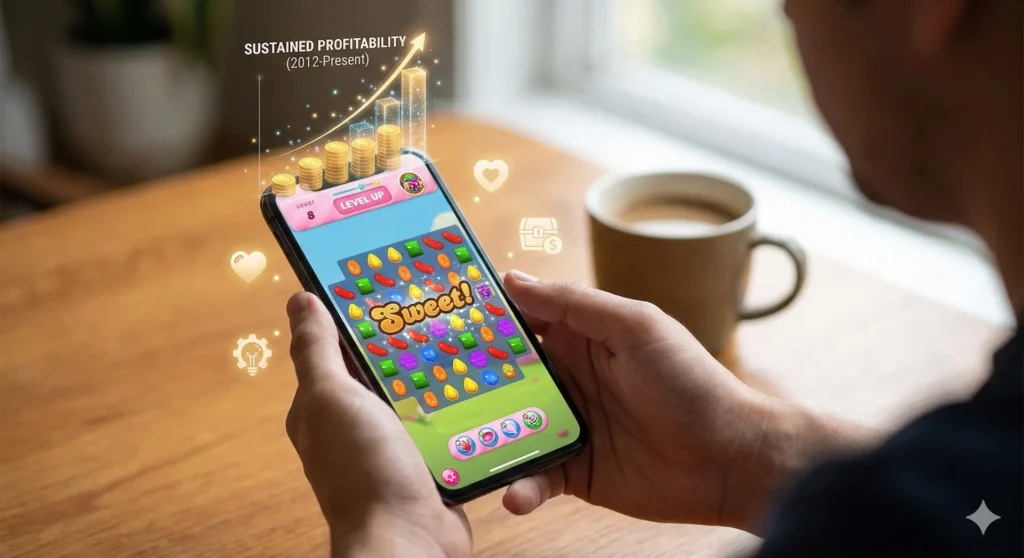
When most mobile games disappear within a few years of release but Candy Crush Saga continues to generate enormous amount of revenue even after more than a decade since its launch in 2012. This game is developed by King and later acquired by Activision Blizzard and remain as one of most successful mobile games in history.
So what exactly is making this puzzle game so profitable even today? So answer of this question lies in a combination of smart game design, psychological engagement, monetization strategies and constant updates.
Below is a detailed breakdown of key reasons behind its long term success and profitability.
One of the biggest reasons for success of Candy Crush Saga is its extremely simple gameplay loop.
Basic mechanics of playing game is easy:
Unlike many other complex games in this game players do not need tutorials or gaming experience. Anyone from children to older adults can easily understand mechanics of playing it within few minutes.
This simplicity has dramatically increases potential audience size of it which directly have impacted downloads and revenue.
Candy Crush have level based progression model which have thousands of levels.
Players experience with new levels :
Because game constantly introduces new challenges players rarely feel that game is repetitive so they keep coming.
Progression map also creates sense of journey in players which encourage players to keep moving forward.
Candy Crush heavily relies on behavioral psychology for increasing engagement.
Some of key mechanics are:
Variable Rewards : Players never know exactly when they will win a level or receive a bonus which triggers same reward patterns seen in gambling psychology.
Near-Miss Effect : Sometimes players fail in a level with only one move left making them to feel they were very close to winning.
Which increases likelihood that they should :
Bright Colors and Sound Design : It have used colorful visuals and satisfying sound effects which trigger dopamine responses in our brain.
Candy Crush have used energy-style system called lives.
In which players have a limited number of lives so when they loose all lives then they must either:
This system is very effective because it create a small friction moments in players so players are willing to spend a little amount of money for continuing playing.
Another reason for game’s success is its balanced monetization design.
Players can purchase:
However game never forces purchases so players feel a balance and many players continue playing without spending money while a smaller percentage of users (often called as “whales”) spend significant amounts.
This free-to-play model have allowed millions of users to join there ecosystem.
Unlike many mobile games which stop releasing new content after years Candy Crush constantly added new levels and episodes.
This ensures:
Continuous content updates are one of major reason this game maintains high retention rates even after so many years.
Candy Crush also have social mechanics.
Players can:
These features increase competition and cooperation which naturally keeps players engaged for longer periods.
After more than a decade Candy Crush has become one of most recognizable mobile game brands in the world.
The franchise expanded into multiple titles which include:
These games help strengthen overall brand ecosystem.
Candy Crush is played across hundreds of countries and attracts players from many different age groups.
Unlike competitive games such as:
Candy Crush focuses on casual gameplay which make it accessible to a much wider audience.
Casual audiences tend to play games for longer periods of time then competitive games which also leads to consistent revenue.
Even after more than 14 years Candy Crush still generates hundreds of millions of dollars annually.
Industry reports estimate that the Candy Crush franchise has generated billions of dollars in lifetime revenue which make it one of highest-earning mobile games ever created.
This shows that simple mechanics + smart monetization + continuous updates can sustain profitability for many years.
This success of Candy Crush Saga is not accidental. Its profitability comes from a carefully designed system that combines:
While many mobile games fade away quickly Candy Crush proves that well-designed casual games can remain profitable for more than a decade.
For mobile developers and gaming companies it remains one of best case studies in long-term game monetization.