Physical Address
304 North Cardinal St.
Dorchester Center, MA 02124
Physical Address
304 North Cardinal St.
Dorchester Center, MA 02124
When Game Freak first started talking about Beast of Reincarnation, studio kept repeating one strange rule about its post-apocalyptic world: “Never look up at sky.” Director Kota Furushima said it plainly in January 2026 Xbox Developer_Direct materials. An ancient legend warned that “something” was floating up there. Players were told—almost pleaded with—not to try to see it for themselves.
Most people treated line as atmospheric flavor. It sounded cool. It sounded mysterious. It sounded like kind of thing a Japanese action RPG says when it wants to feel deeper than it is. Then game launched on August 4, 2026 and players discovered warning was not flavor at all. It was a working mechanic, a lore bomb and earliest, most elegant clue to story’s biggest revelations.
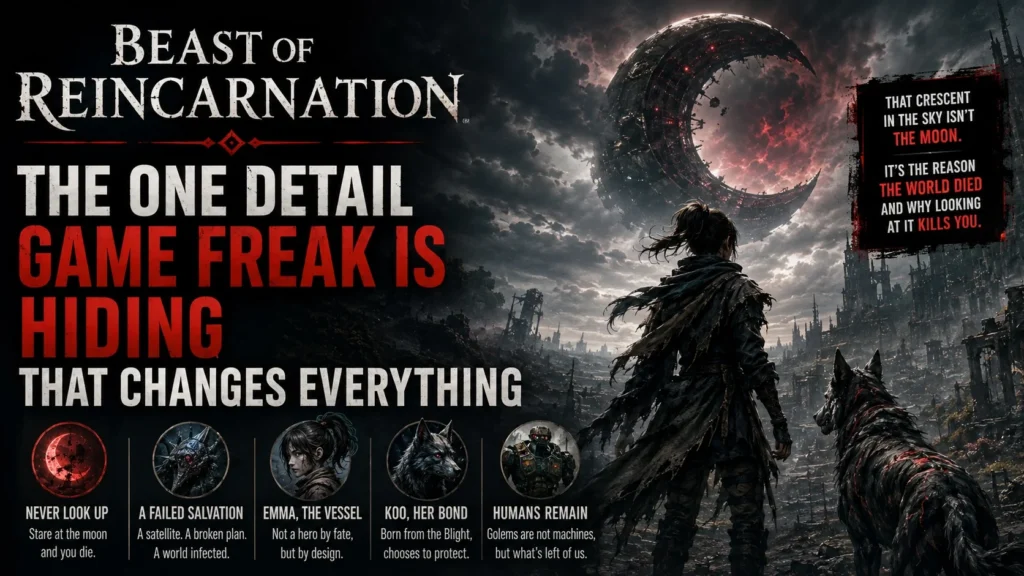
That single detail changes how entire game reads.
If you stare at crescent moon in Beast of Reincarnation for more than a few seconds, Emma’s health begins draining. Within roughly five seconds she collapses and dies. The game awards “Horror in Sky” trophy for act. This effect is available from moment you gain control in Chapter 1 and remains active for entire campaign. Even after trophy is unlocked, looking directly at that object in sky will still kill you.
NPCs reinforce prohibition constantly. Looking upward is treated as fatal and outlawed. The crescent moon is described as looking like a broken object or a dark cloud rather than a natural celestial body. Whole setup feels deliberately mischievous like something Hideo Kojima might have slipped into one of his games. Game Freak knew players would disobey warning second they could. They built punishment, reward and narrative payoff into same interaction.
What makes mechanic special is not cheap death. It is how cleanly it connects surface experience to hidden truth of world.
Late in game through Brad’s recordings and revelations in Chapter 10, sky finally makes sense. Two thousand years before events of story humanity faced extinction from cascading crises—war, climate collapse, epidemics and a deep spreading despair that stopped people from having children. In response scientists attempted something radical: they tried to strip negative emotions from human soul. That experiment failed. This repressed emotions corroded people’s minds and bodies.
A new plan emerged called Project Shambhala. A digital copy of world was built as a temporary refuge. Souls would be uploaded and held there until Earth became livable again. This transfer system required a buffer. That buffer was a swarm of biomechanical nanobots true Beast of Reincarnation that generated particles called Brahman. These particles were designed to attune to human souls so a large satellite could beam them into Shambhala.
The satellite is crescent moon hanging in sky of 4026.
The system did not work as intended. Brahman proved incompatible with many souls. Rejection caused further erosion. Particles multiplied without limit, infecting plants, animals and remaining humans. That infection became Blight. Satellite stayed in orbit both failed salvation device and a constant, lethal reminder of what went wrong. Looking at it kills because of residual effects of system itself.
Suddenly early marketing warning is not atmospheric fluff. It is first most honest piece of exposition in entire game.
Once you understand sky, rest of narrative snaps into a different shape.
The Blight is not a natural or purely supernatural force. It is toxic byproduct of a technological solution that escaped control. Malefacts and Nushi are living consequences of that failure.
Emma is not simply a chosen warrior. She is a synthetic Vessel designed to absorb and contain very corruption old system created. Her title as Sealer or Purifier takes on a colder more engineered meaning.
Koo is not just a loyal companion. As a Malefact himself he embodies same corrupted life that satellite system helped unleash. Their bond becomes a living contradiction: product of Blight choosing to protect one person who can seal it.
The golems are not mere robots. They are humans who survived soul corrosion long enough to transfer into mechanical shells. Their “last words” are final echoes of people left behind when Shambhala received rest.
The Beast of Reincarnation is not a demon. It is original transfer system—now autonomous, corrupted and still trying to fulfill a broken purpose. Later revelations push this further: system and certain characters become entangled in desires that have nothing to do with saving humanity and everything to do with personal happiness inside a failed digital paradise.
What begins as a stylish Soulslike-adjacent action RPG about a lonely girl and her dog becomes a story about failed digital immortality, the cost of emotional engineering and whether a being without a soul can earn one through connection and choice. The sky rule is quiet proof that Game Freak was planting sci-fi core of narrative from very first public statements.
Beast of Reincarnation is studio’s largest non-Pokémon project in years born from an internal Gear Project initiative that encourages staff to pitch original ideas. The “never look up” detail shows a level of narrative confidence and environmental storytelling that feels distinct from mainline Pokémon games. It is kind of quiet, player-hostile-yet-rewarding design choice that suggests team understood exactly how their audience would behave and decided to make that behavior part of the story.
Game has its share of criticisms—repetitive structure, performance issues at launch storytelling that some find overcomplicated—but sky mechanic is not one of them. It is a small perfectly executed piece of design that bridges marketing, gameplay and lore. Few studios manage to turn a throwaway line from a developer blog into a lethal environmental hazard that also functions as key to plot’s biggest twist.
In a year crowded with ambitious action RPGs that kind of precision stands out.
Game Freak did not bury truth. They put it in sky and told everyone not to look. Then they made looking fatal, memorable and thematically essential. Players who ignored warning and died for trophy got punchline early. Players who waited until late-game revelations got full weight of setup.
Either way, the rule works. “Never look up at sky” is no longer just a cool line from a pre-release interview. It is one detail that quietly recontextualizes Emma’s entire journey, nature of Blight, identity of Beast and failed dream of Shambhala.
And once you know what is floating up there it is almost impossible to look at game same way again.