Physical Address
304 North Cardinal St.
Dorchester Center, MA 02124
Physical Address
304 North Cardinal St.
Dorchester Center, MA 02124
Lies of P arrived on Nintendo Switch 2 last week as a Complete Edition bundling 2023 base game with excellent Overture expansion and years of quality-of-life updates. For many players this is first chance to take one of strongest Soulslikes of last generation into pure portable form. The question that matters most is simple: how well does a demanding, precision-focused action RPG actually run on Nintendo’s hybrid hardware?
The short answer is that it runs better than most expected with real compromises that never quite break the experience. The longer answer requires looking at modes, day-one (and post-launch) patches and what those trade-offs feel like in practice.
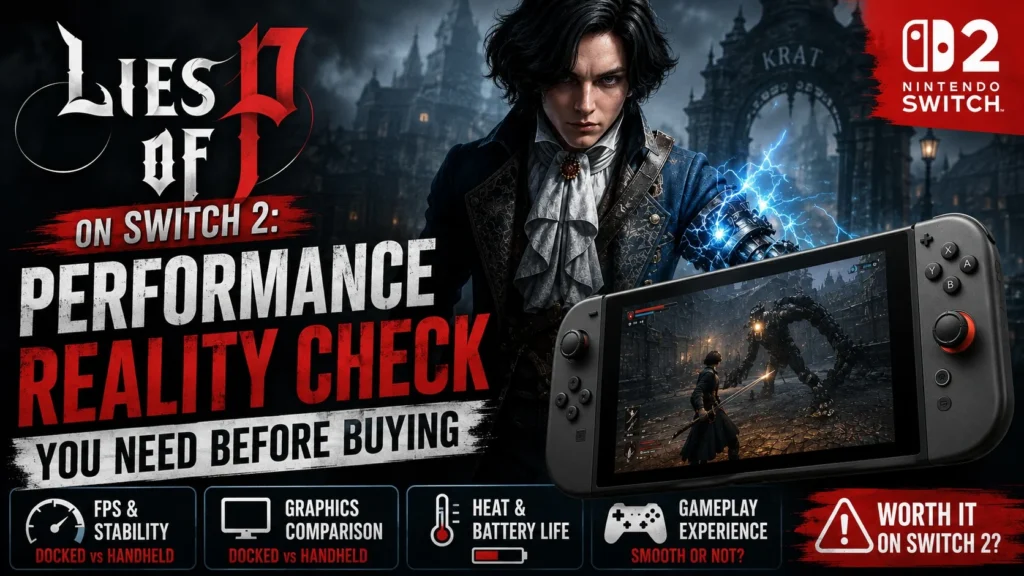
Lies of P: Complete Edition launched digitally on August 6, 2026 with a physical cartridge version arriving in early October. This package includes full base game, Overture DLC, difficulty options added after original release and various balance and QoL patches that have refined combat since 2023. File size sits around 37–38 GB.
This is not a stripped-down port. Core systems—weapon assembly (blade and handle mixing), Legion Arms, perfect-block timing and dense, interconnected level design of Krat—are intact. The question is whether Switch 2 can deliver those systems with enough consistency that game still feels fair and satisfying.
This game offers separate options for docked and handheld play.
Docked gives you three choices:
Handheld originally launched with only Performance and Quality. Quality was widely described as rough—noticeable stuttering and inconsistent delivery that made precise combat feel unreliable. Performance was more playable, running at a variable rate that benefited heavily from Switch 2’s VRR support. Image quality was softer and resolution lower (frequently cited around 720p internal) but smaller screen helped mask some of softness.
A patch (Version 1.13.1.0) arrived quickly after launch. It added a new Performance-centered option for handheld that supports up to 60 fps, renamed previous Performance mode to Balanced, fixed a resolution bug in Quality mode, improved overall stability and added a motion-blur toggle for TV play. Post-patch feedback has been notably more positive. Many players now treat handheld Balanced as practical sweet spot—respectable visuals with a frame rate that feels smooth enough on 120 Hz VRR screen while pure Performance prioritizes higher target at cost of more softness and reduced effects.
Texture and object pop-in is most consistent complaint. Distant buildings, environmental details and some mid-ground geometry can appear suddenly when camera pans or when entering denser areas. It is rarely severe enough to break immersion for long but it is frequent enough that you stop being surprised by it.
Image softness is another constant in performance-oriented modes. Character models hold up reasonably during regular play but close-ups and cutscenes make reduced texture quality obvious. The art direction—Belle Époque architecture mixed with grotesque puppet designs and atmospheric lighting—still reads strongly. World of Krat does not suddenly look cheap; it simply looks less refined than PS5 or high-end PC versions.
Loading times on internal storage are serviceable (title screen to gameplay around 15 seconds in early tests, respawns closer to four seconds) but clearly slower than current-generation home consoles. None of these issues prevent game from being enjoyable. They simply establish ceiling.
Combat is real test for any Soulslike port. Lies of P lives and dies on perfect-block timing and fluidity of its weapon system. higher frame-rate modes (especially docked Performance and post-patch handheld Performance option) make that timing feel reliable. Even in more stable 30 fps Quality modes, attack animations remain clear enough that skilled players can still land perfect blocks consistently. This game does not become unfair because of hardware limitations.
Exploration and boss fights benefit from same strengths that made original so well-regarded: inventive level design with frequent shortcuts, memorable enemy and boss designs and a combat system that rewards experimentation with weapon combinations. Playing through large stretches of game in handheld Performance or Balanced after patch feels surprisingly close to experience on more powerful hardware once you adjust to softer image.
Docked play is clearer winner for pure visual quality and consistency. Handheld is more impressive achievement simply because a game of this density and mechanical precision works as a portable experience at all.
Lies of P on Switch 2 is a competent well-supported port of an excellent game. It is not definitive version. Players who prioritize maximum fidelity, locked high frame rates and sharpest possible image will still prefer PS5, Xbox Series X or PC. Those who value ability to play a top-tier Soulslike anywhere—on the train, on the couch or in bed—will find Switch 2 version more than good enough.
The performance reality is this: expect noticeable but manageable visual compromises, occasional pop-in and a frame rate that is “acceptably stable and playable” rather than perfect. Expect combat to remain fair and satisfying. Expect Complete Edition package (base game + Overture) to deliver full experience without feeling truncated.
If those trade-offs sound acceptable in exchange for true portability this is one of the stronger third-party ports Switch 2 has received so far. If you are extremely sensitive to soft resolution or any inconsistency in frame delivery wait for a deeper sale or stick with another platform. For everyone else the puppet is ready to travel.