Physical Address
304 North Cardinal St.
Dorchester Center, MA 02124
Physical Address
304 North Cardinal St.
Dorchester Center, MA 02124
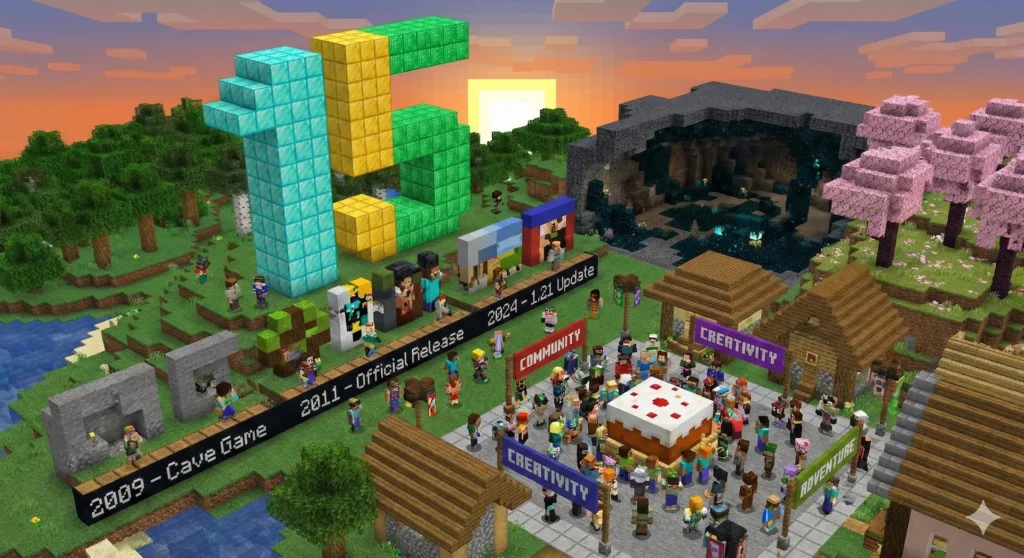
In gaming industry 15 years is not just a longevity but it is dominance because only few survive so far.
Most of titles spike, peak and mostly decline in 2 to 4 years. Biggest franchises also struggle to maintain there position in market if they don’t release sequels so you mostly have seen sequels of games which are alive. But Minecraft was released in 2011 and is continuing ranking in most played, most watched on YouTube and most
So there is a real question is not “Why was Minecraft successful?”
but It’s “Why hasn’t it slowed down?”
Let’s break this down structurally — from game design, psychology, business strategy, and community economics.
Now let’s break everything from game design, psychology, business strategy to community economics into structures.
Most games are content-driven.
They mostly rely on:
Once everything consumed then their engagement declined with time.
While Minecraft is system-driven.
Its core loop is built on top of:
There is no predefined “main story” which is forcing player into a certain direction. Player defines its own objectives.
This only remove natural expiration date which most games suffer.
Minecraft have used procedural generation based on world seeds.
So each new world:
Which make every play structurally different from other.
In traditional open-world games curiosity drops when map is memorized. But in Minecraft this exploration remains always dynamic.
From a retention standpoint, that’s a massive advantage.
This is massive advantage in terms of retention of player.
Minecraft supports two fundamentally different player motivations.
This satisfies for players who enjoy challenge, tension, and structured growth.
This satisfies players who enjoy expression and imagination a lot.
Very few games have successfully support both competitive survival players and pure creators without alienating either group.
But Minecraft have done it.
Minecraft looks very simple at surface level.
But Redstone mechanics introduce:
Players have created:
This adds intellectual depth which is rarely seen in any mainstream games.
This complexity ceiling is extraordinarily high which means advanced players have never “done learning.”
One of Minecraft’s greatest strategic advantages is its modding community.
Mods introduce:
Essentially players continuously expand game’s scope.
Instead of releasing sequels every few years So core game evolves organically.
When Microsoft acquired Minecraft this ecosystem expanded further with cross-platform support and marketplace integration without dismantling community creativity.
That balance was critical.
Minecraft is arguably most content-friendly game ever created by anyone.
It works perfectly for:
Content creators generate:
Each video of it have act as organic marketing for it.
Viewer → Inspired → Plays → Creates → Shares.
This loop compounds over time.
Unlike all other competitive esports titles which fluctuate based on meta shifts, Minecraft content remains evergreen.
Minecraft runs on:
It doesn’t require a high-performance GPU.
This makes it accessible in emerging markets where hardware limitations restrict AAA adoption.
Accessibility is always equals to scale and scale equals longevity.
Minecraft is not just for entertainment but it’s also an educational tool.
Used for:
This expands audience beyond traditional gamers.
When a game becomes integrated into education systems it transitions from “trend” to “infrastructure.”
This shift protects long-term relevance of it.
Minecraft leverages three core psychological drivers:
Players decide their own goals.
There is no forced narrative.
Complex building systems encourage player to skill growth.
World persistence has created emotional investment.
When a player builds a base over months that world becomes personal for him.
Abandoning it feels like losing something that is real for him.
This emotional anchoring drives return behavior of player.
Many long-running games decline because updates:
Minecraft updates cautiously:
There core loop remains untouched even today and that consistency have build trust.
Public and private servers have transformed Minecraft into a social platform.
Players join:
Friend networks become embedded inside game.
Social stickiness significantly increases retention of any game.
When your friends play there may be a chance you will return.
Minecraft’s block-based design avoids hyper-realism visuals.
Hyper-realistic games age visually within 5–7 years.
Minecraft’s minimalist style:
Stylization often outlives realism.
Creepers, diamonds, crafting tables that are instantly recognizable.
Merchandising, conventions, community events, and pop culture references reinforce brand presence.
Once a game becomes culturally symbolic then it stops competing solely on mechanics.
It becomes part of digital identity.
Minecraft thrives because it:
Most games provide experiences.
Minecraft provides a platform for experiences.
That distinction explains why, 15 years later, it is not surviving but it is thriving.