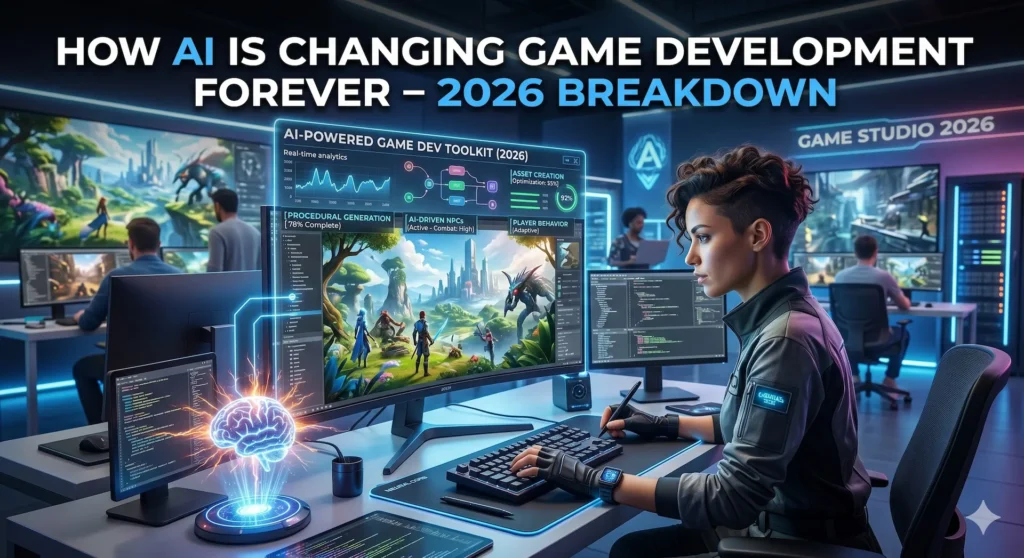
AI is fundamentally reshaping game development in 2026 moving from experimental tools to core infrastructure that accelerates production, enhances creativity and enables entirely new gameplay paradigms. What once took teams of dozens months or years to build can now iterate in weeks all thanks to generative AI, agentic systems and specialized models. This isn’t about replacing developers—it’s about augmenting them and reducing repetitive grunt work and letting humans focus on vision, polish and innovation.
1. Massive Speedup in Production Pipelines
Game development has always been notoriously expensive and time-intensive. In 2026 AI slashes that timeline across pre-production, asset creation, coding and testing.
Asset Generation: Text-to-3D tools (like Tripo, Meshy or integrated Unity AI generators) produce game-ready models, textures, animations and even rigged characters from prompts. These often require minimal cleanup for Unity/Unreal import, handling topology, optimization and low-poly needs. AI also tackles concept art, sprites, materials and audio/SFX.
Code and Architecture: Tools like GitHub Copilot successors, Claude Code, Cursor, JetBrains AI and Unity AI’s Agent mode handle scripting, debugging, refactoring and even high-level architecture suggestions. They understand entire codebases (“repository intelligence”) reducing technical debt and enabling faster prototyping. AAA studios quietly double down on these for velocity.
World Building: Procedural generation evolves beyond traditional algorithms (e.g., No Man’s Sky-style math) to AI-driven systems that create coherent, thematic environments, levels, quests and narratives with internal logic. Google’s Genie models and similar “world models” point toward dynamic, navigable worlds generated or simulated on the fly.
Result: Studios report weeks—not years—for certain assets and modules. Mobile game devs, in particular, use AI agents for balancing, localization and LiveOps with ~87-90% adoption in surveys. Indie teams and smaller studios benefit as “the great equalizer,” lowering barriers dramatically.
2. Smarter, More Lifelike NPCs and Gameplay
This is where AI feels truly transformative for players.
Dynamic Characters: Platforms like Inworld AI (often paired with NVIDIA ACE) power conversational, memory-equipped NPCs with emotional intelligence, adaptive behavior and natural speech/animation. Characters remember past interactions, player tone and choices across sessions—moving far beyond static dialogue trees. NVIDIA’s Audio2Face, Riva ASR and related tech enable real-time facial animation and voice. Demos like Covert Protocol showed unique player-driven narratives.
Adaptive Experiences: Games now feature personalized storylines, difficulty that responds to playstyle and emergent gameplay. Agentic AI handles complex interactions while on-device models reduce latency for responsive feel.
Testing and Balancing: AI agents automate playtesting, bug detection and analytics, catching issues faster and enabling rapid iteration.
GDC 2026 reportedly featured over 100 AI-related sessions, highlighting its dominance in rendering, audio, movement, anti-cheat and full-stack pipelines.
3. Scale of Adoption in 2026
Numbers tell the story:
Over 4,300 games on Steam disclosed AI use by end of 2025; predictions suggest 7,000+ in 2026, with roughly 1-in-3 new releases tagged. About 22% of 2025 Steam titles already used it.
~50% of studios actively integrate AI; 90%+ of developers use it in workflows per Google Cloud data with most saying it cuts repetitive tasks and boosts creativity.
Integration everywhere: Unity AI suite (contextual help, asset gen directly in-editor), Unreal enhancements, NVIDIA tools and third-party like Scenario.gg for game-specific assets.
AI-Native Games are emerging—experiences where AI forms core (dynamic worlds, evolving narratives) rather than just assisting production. While fully autonomous “playable AI worlds” still face consistency and cost hurdles, hybrids are shipping.
4. Challenges and Realistic Outlook
AI isn’t a magic bullet:
“AI Slop” Risk: Generic or low-quality generated content frustrates players. Success requires strong human oversight, curation and fine-tuning for style/consistency.
Limitations: World models can break after minutes; high-fidelity real-time generation remains expensive. Ethical concerns (training data, job impacts, disclosure) persist, though Valve’s Steam policies push transparency.
Doesn’t Replace Humans: Creativity, emotional depth, cohesive vision and final polish still demand skilled developers. AI excels at scale and iteration but struggles with true novelty or avoiding uncanny valleys without direction. Studios emphasize it as a co-pilot.
On-Device vs. Cloud: Latency and cost drive more local inference (e.g., via NVIDIA GPUs), especially for NPCs.
Predictions for broader impact in code architecture, cinematics and analytics are materializing but full end-to-end AI-built AAA titles remain aspirational rather than standard.
The Bottom Line: Forever Changed But Human-Driven
In 2026, AI democratizes high-quality game creation while enabling richer, more responsive experiences. Smaller teams can compete on scope; big studios ship faster with deeper immersion. The best outcomes come from hybrid workflows—AI for tedious and generative, humans for soul and strategy.
For aspiring devs, learning prompt engineering, AI toolchains (Unity/Unreal integrations) and traditional fundamentals (design, systems thinking) is key. Tools evolve fast but taste and iteration skills endure.
The industry isn’t “cooked”—it’s evolving into something more accessible and dynamic. Games will feel more alive, worlds more infinite and development less bottlenecked by manpower. The real winners will be those who wield AI as a powerful brush not a crutch. What specific aspect—NPCs, asset pipelines or getting started—interests you most?