Physical Address
304 North Cardinal St.
Dorchester Center, MA 02124
Physical Address
304 North Cardinal St.
Dorchester Center, MA 02124
Capcom Co. Ltd. stands as one of video game industries most enduring and influential companies. Founded in Japan it evolved from arcade hardware roots into a global powerhouse known for groundbreaking franchises that defined genres like fighting games, survival horror, action-adventure and monster-hunting action. Its story begins in late 1970s with humble origins in electronic game machines and explodes into cultural phenomena starting with Street Fighter. This updated 2026 overview traces complete history through key eras, major releases and milestones, culminating in launch of their ambitious new IP, Pragmata.
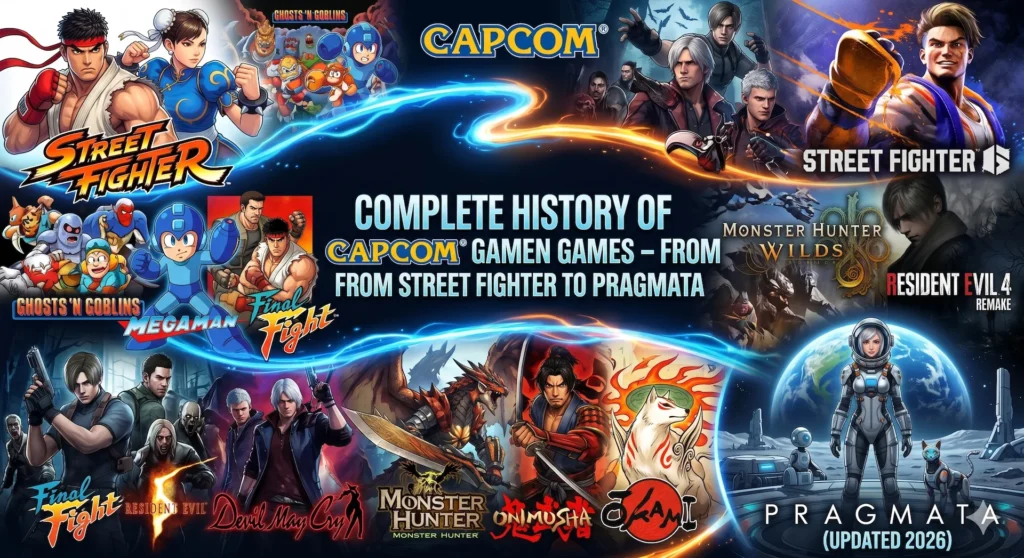
Capcom’s predecessor, I.R.M. Corporation was established on May 30, 1979 by Kenzo Tsujimoto in Osaka to develop and sell electronic game machines. After name changes (to Sanbi Co., Ltd. in 1981) and internal restructuring, Capcom Co. Ltd. was officially founded on June 11, 1983 as a software sales arm name “Capcom” deriving from “Capsule Computers,” evoking fun packed software protected like a hard shell.
Early releases focused on arcades: medal game Little League (July 1983), Fever Chance (October 1983) and company’s first true arcade video game, Vulgus (May 1984). The breakthrough came with 1942 (December 1984) a WWII themed shooter that targeted international markets and proved Capcom could compete globally. Hits like Commando and Ghosts ’n Goblins (both 1985) followed, cementing their reputation. In December 1985, Capcom ported 1942 to Nintendo Entertainment System (NES) their first home console release marking shift from arcades to living rooms. Capcom U.S.A. was established in 1985 to support North American distribution.
August 1987 marked a turning point with arcade launch of Street Fighter. Though original was solid its 1991 sequel, Street Fighter II revolutionized the industry. It popularized one-on-one fighting games, introduced iconic characters (Ryu, Chun-Li, etc.) and became a massive arcade and home hit, spawning countless sequels, tournaments and crossovers like Marvel vs Capcom series.
That same year (December 1987), Capcom released Mega Man on NES, launching a platforming franchise beloved for its challenging levels, robot-master bosses and memorable music. The series expanded rapidly across consoles.
The 1990s brought diversification. Final Fight (1989 arcade) popularized beat-’em-ups. Resident Evil (1996, originally Biohazard in Japan) debuted on PlayStation and invented survival horror genre with its fixed-camera tension, zombies and resource management—becoming a flagship franchise with billions in sales. Other notables included Devil May Cry (2001 though rooted in Resident Evil 4 concepts) which birthed stylish action.
The new millennium saw Capcom adapt to 3D. Devil May Cry (2001) delivered fast-paced, combo-heavy action starring Dante. Monster Hunter (2004) started modestly but exploded into a global phenomenon with cooperative hunting, deep crafting and multiplayer appeal—later dominating with Monster Hunter World (2018) and beyond.
Other successes: Dead Rising (2006) zombie sandbox, Ace Attorney visual novels and Dragon’s Dogma (2012) open-world RPG. The company faced challenges—arcade decline, some misfires like Resident Evil 6 (2012) but refocused on core strengths.
Capcom embraced high-fidelity remakes using RE Engine. Resident Evil 2 (2019), Resident Evil 3 (2020), and Resident Evil 4 (2023) remakes revitalized series with modern graphics and gameplay. Street Fighter 6 (2023) modernized fighting genre with robust single-player modes and online features. Monster Hunter Rise (2021) and Monster Hunter Wilds (2025) continued franchise’s dominance.
The company balanced legacy ports, legacy collections (Mega Man, Street Fighter) and new experiments while expanding to PC, mobile and next-gen consoles (PS5, Xbox Series X|S, Nintendo Switch 2).
Capcom’s history of bold new IPs reaches its latest milestone with Pragmata released April 17, 2026 (PS5, Xbox Series X|S, PC via Steam, Nintendo Switch 2; Japan Switch 2 on April 24). Announced in 2020 as company’s first original franchise in years and development spanned six years with RE Engine’s advanced tech (path tracing, ray-traced lighting, strand-based hair).
Set on a lunar research station it is a third-person sci-fi action-adventure where players control Hugh (firearms, jetpack) and android Diana (hacking puzzles) simultaneously. Real-time grid-based hacking mixes with shooting against rogue AI robots. The story explores father-daughter bonds, AI ethics and a mysterious lunar catastrophe. A demo (Pragmata: Sketchbook) launched late 2025. Early reception praises innovative co-control gameplay, visuals and emotional narrative.
2026 also features supporting releases like updated Resident Evil 2 and Resident Evil 3 editions (April 2), Monster Hunter Stories 3: Twisted Reflection (March), Onimusha: Way of the Sword and Mega Man collections—showing Capcom’s mix of nostalgia and innovation.
From Street Fighter’s arcade frenzy to Pragmata’s lunar puzzles Capcom has consistently pushed boundaries while honoring its legacy. With a focus on quality, player-focused design and global appeal, the company enters its fifth decade stronger than ever entertaining millions and inspiring next generation of gamers and developers.